This page introduces several key concepts important for understanding sociotechnical challenge modelling. These concepts include:
- The Machine Learning-Enabled Care Pathway
- Sociotechnical Challenges
The Machine Learning-Enabled Care Pathway
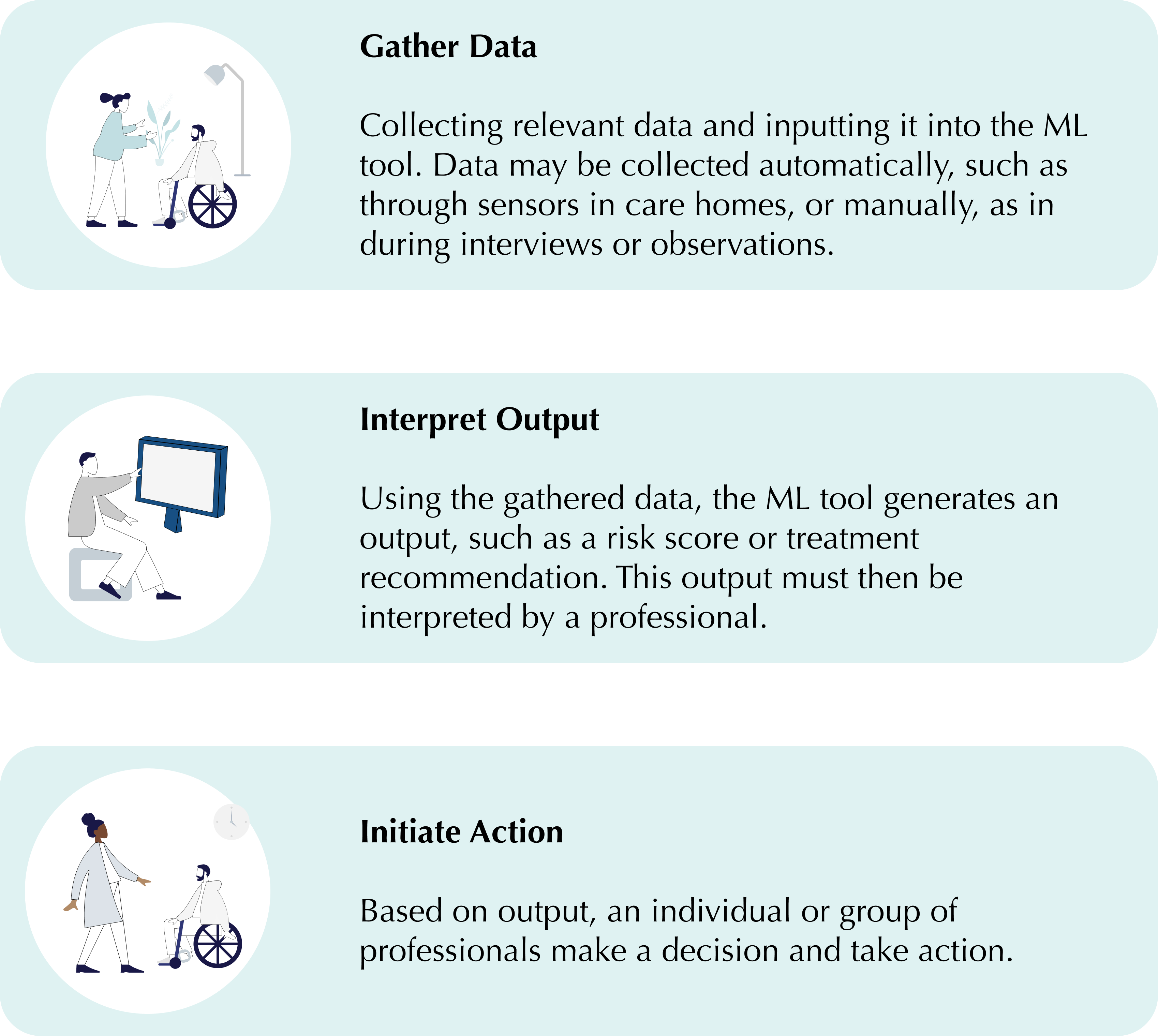
The Machine Learning-Enabled Care Pathway outlines a high-level structure for using ML tools in health and social care. It consists of three stages:
Example Use Cases
In a children’s social care agency, practitioners use a ML tool when prioritising referrals. When call screeners receive a referral, they gather information about the child and family and input those details into the ML tool. The ML tool then generates a risk score between 1 (low risk) and 10 (high risk). Using the risk score and other information known about the current allegation, the call screener decides whether to accept the case. Depending on the call screeners’ decision, the case is either screened-out or passed along to a case worker for further investigation.
A US hospital system recently deployed a ML tool to predict which patients are at risk of developing sepsis. The ML tool analyses patient data, such as vital signs and lab results, to generate a risk score. When a patient’s risk score exceeds a certain threshold, the ML tool sends an alert to the patient’s care team. The care team then decides whether to intervene and provide additional care to the patient.
Sociotechnical Challenges
Sociotechnical challenges are the consequence of interactions between technical and social factors as ML tools are put into routine use. These challenges represent mismatches between the organisation of care work and how a ML tool works.
Through our research, we have identified 10 different types of sociotechnical challenges for ML tools in health and social care. Each challenge is likely to arise at a different stage of the ML-Enabled Care Pathway (Figure 3.1).
We have distilled these challenges into separate concepts which indicate the stage at which the challenge is likely to arise, its title, a description, an example, and sensitising questions.
Gather Data Challenges
Challenge 1: Data Inconsistencies
Data on which the ML tool makes predictions are inconsistent with the expected structure, type, or unit.
Example
A local authority uses a ML tool to identify risks among adult social care service users by analysing case notes. Different social workers write case notes at varying levels of detail and length, affecting the ML tool’s performance.
Questions
- Is there any variation in the way we collect data?
- What processes and procedures do we have in place that guide data gathering?
- What skills, techniques, and tools do we need to gather and prepare data into the required format?
Challenge 2: Poor Environmental Conditions
The physical workplace environment in which the ML tool operates directly affects the quality of data it processes.
Example
A ML tool is used in a hospital to analyse images of patients’ eyes to detect disease. A technician takes a picture of a patient’s eye in a poorly lit room leading to a low quality image.
Questions
- Does the ML tool use any data that is affected by environmental factors (e.g., lighting, temperature)?
- What aspects of our workplace environment may affect the data analysed by the ML tool?
Challenge 3: Data Restrictions
Access to the data on which the ML tool generates predictions is restricted.
Example
A ML tool is used by a local authority to determine how likely older adults living in the community are to fall. But, due to the data protection concerns of service users, the ML tool cannot use factors such as age or gender to make predictions.
Questions
- What internal or external policies affect which input data we can use?
- Are we reluctant to share data with other groups or organisations? Are other groups or organisations reluctant to share data with us?
- What variables do we want the ML tool to use but currently cannot?
Interpret Output Challenges
Challenge 4: Mismatched Objectives
The objectives considered by stakeholders when making decisions differ from the variable predicted by the ML tool.
Example
Case workers prioritise short-term risk by screening-in referrals to a care agency if they consider a child to be at risk of abuse. The ML tool prioritises long-term risk by screening-in referrals if it predicts that the child will be re-referred to the care agency at some point in the future.
Questions
- What is the outcome that stakeholders consider when making care decisions?
- What is the outcome that the ML tool is trying to predict?
- What outcome do we want stakeholders to consider when making care decisions?
Challenge 5: Hidden Predictors
Stakeholders rely on contextual information not captured in data to assess the validity of the ML tool’s predictions.
Example
A ML tool is used in a hospital to predict whether a patient is likely to have a successful surgery. Rather than only rely on the tool’s predictions when making a decision, surgeons also consider factors unrelated to patients’ conditions, such as their own workload.
Questions
- What factors do we consider when making care decisions?
- What factors (i.e., variables) are considered by the ML tool when making predictions?
- What happens if a person’s decision is different from the tool’s prediction? Who is accountable if things go wrong?
Challenge 6: Decision Point Disconnect
The intended user group does not come in contact with the ML tool when making care decisions.
Example
A ML tool is used in a hospital to support decisions for whether a patient should undergo surgery. Yet, the clinicians who are the intended users of the ML tool make most of their decisions in the wards and rarely come in contact with a computer.
Questions
- Where are the intended users of the ML tool when they make care decisions? Do they have easy access to a computer?
- How are the outputs of the ML tool being disseminated to those making care decisions?
Initiate Action Challenges
Challenge 8: Value Conflicts
Use of the ML tool reveals conflicting interpretations of organisational values among stakeholders.
Example
A ML tool is used in a hospital to identify individuals eligible for a preventive care programme. Different stakeholder groups in the hospital debate what amount of human control over the ML tool would reduce the risk of errors.
Questions
- What values and motivations are most at stake when using the ML tool?
- Are there disagreements or conflicts over these values and motivations?
- How do we typically resolve value conflicts in our organisation?
Cross-cutting Challenges
Challenge 9: Disrupted Workflows
Use of the ML tool challenges existing workflows and lines of communication.
Example
A ML tool is used in a hospital to identify patients who may be at risk of sepsis. Clinicians traditionally relied on seeing and speaking with patients to make a diagnosis. Now, sepsis diagnoses are made without any patient interaction.
Questions
- Is there a specific process or workflow that must be followed when using the ML tool?
- How does this workflow align with our existing care workflows?
- Do stakeholders have flexibility in deciding how they follow the tool’s workflow?
Challenge 10: Limited Understanding
Stakeholders possess limited understandings of how the ML tool functions.
Example
A ML tool is used in a hospital to analyse X-ray images to identify lung cancer among patients. In some instances, the radiologists do not know why the ML tool flags an area in the image as abnormal tissue.
Questions
- What do different stakeholders know about the ML tool?
- What does each group need to know about the ML tool?
- Does the interface provide any clues about how the ML tool functions?
- How can we help stakeholders learn about the ML tool?
Challenge 11: Additional Labour
Use of the ML tool demands additional, previously unperformed work.
Example
A ML tool is used by a local authority to predict a child’s risk of maltreatment. To use the ML tool, social workers have to manually type in the child’s family information as an input for the tool to generate a prediction.
Questions
- What tasks are needed to prepare the data that is used by the ML tool to make predictions?
- What tasks are required to over-ride the tool’s predictions?
- Are the benefits of using the ML tool greater than the costs?
- Are there incentives in place for people to perform the necessary tasks?